VolksNav© in Shenyang
Shenyang has the option to be world's first city that has realized an international orientation standard, an idea from a Munichian inventor to simplify and harmonize worldwide all orientation means: signage, cartography, postal codes, navigation devices and verbal expressions.
Within this city, it is (will be) possible to find any target with easy brain work, that means
| - without maps, | - without names, |
| - without illogical numbers | - without arrows |
| - without floor marks | - without square grids |
| - without colors | - without compass or other navigation devices |
Buildings, crossings, stop points, bridges etc. have logical addresses like
Zoological garden StatusQuo© Shenyang m4 r20
Shenyang station m9 r50
Olympic stadium m5:25 r63
Taoxian airport m5:60 r180
which are easy to understand if you associate the city with a clock as follows:
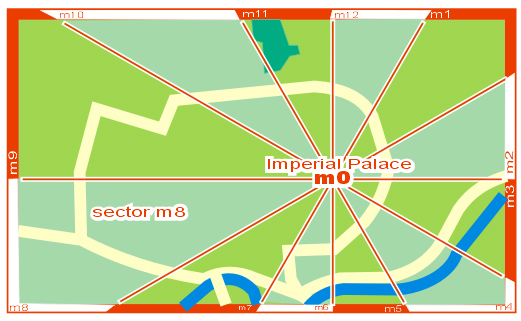
An outstanding point as e. g. the Imperial palace was (will be) defined as a pole m0. Around this pole, the horizon is divided in 12 "horizon hours" m1 to m12 , whereas m12 points to north. This divides the city as a cake in 12 imaginary sectors. As an example, the sector m8 was marked. |
 |
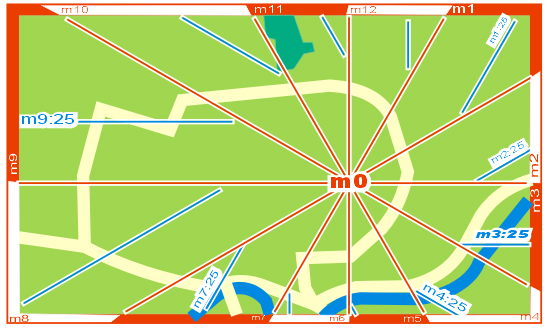 |
The sectors are divided in horizon minutes. These are not angles but DISTANCES to the horizon hour, in steps of approx. one "block of houses" or 100 meters.
Example m3:25 ( read "emm 3 point 25" or "emm three 25" ). This is a line situated in a distance of 25 x 100m from the horizon hour m3, which points to sunrise.. The convention for horizon minutes is very simple: the greater, the later. |
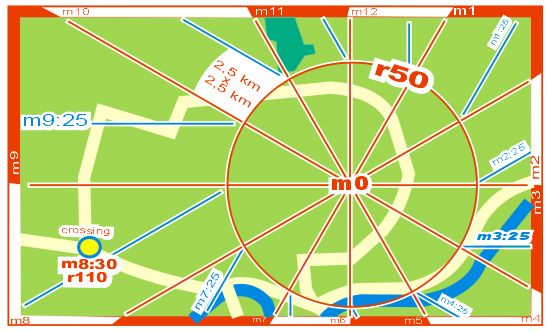
Considering the distance to m0 as r = radius also in steps of blocks of houses, logical position codes for targets, buildings, crossings etc. come into existence, e. g. as shown on the picture: crossing StatusQuo© m8:30 r110 StatusQuo means "where you are". In simple words: "r" is a numbering starting FROM m0, "m" is a north-direction-based numbering AROUND m0 |
 |
This simple methode covers a gigantic market gap:
l o g i c a l and easy understandable p o s i t i o n codes.
Natural Cartography
A map with such a polar grid has innovative characteritics, see www.volksnav.com/map . Please be aware about the fact that if the target isn't on map, with the help of the logical position code it's possible to imagine where it is situated !!
Interesting details:
- the search grid contains quadrangules similar to the conventional ones. The picture above shows a white quadrangule with the dimensions 2.5km x 2.5km. The bended sides let know in which direction the urban pole is situated, even if the centre isn't on map.
- the width of the sector is half the radius !! Example: m8:25 r50, m8:50 r100 etc..
- the middle of the sector is radius/4. Example: m8:25 r100
Other examples for logical position codes:
| Sun Bird | m9:6 | r19 |
| Wulihe stadium | m6:20 | r48 |
| north station | m10:10 | r27 |
Signage
StatusQuo© addresses will be integrated within the existing signage, see www.volksnav.com/lollipop, or be indicated on so-called Orientators©, the signage of the future.
|
Vertical Pointing©: additional to the position information, a round symbol called center or pole pointer will be placed on their periphery to allow to detect the direction m0 according to the following conventions:
etc. Acc. to the same convention, a square symbol points to north = m12. The picture reveils: m12 is behind, the pole is right hand |

Orientator© |
VolksNav©
The local navigation with the help of such codes is called VolksNav©. As proceeded today with house numbers, VolksNav© is nothing else than the major/minor comparison between "r" and "m" values:
Simply proceed according to 1 -2 -3 :
| 1 -
Positioning
|
Turn your body until m0 will be BEHIND. In this position,
etc. Beginners have to turn physically, after some exercises anyone will be able to do this by his imagination power. In case you look at above shown Orientator©, you'd have to turn to left, correct? |
|||||||||
| 2 -
r-comparison
|
Ask yourself: must I move inwards or outwards? ( = is the target radius greater or smaller than the actual one?) |
|||||||||
| 3 -
m-comparison
|
Ask yourself: must I move to “later” (clockwise) or to earlier? ( = is the target m later or earlier than the actual one?)
|
Let's see an example:
Your target is: Olympic stadium m5:25 r63
If you've lost orientation on named crossing m8:30 r110,
so you must go
- to "earlier" (counterclockwise) ( m5 is "earlier" than the actual m8 )
and
- inwards (radius r63 is less than actual r110 )
This may seem to be unfamiliar, but the orientation based on cardinal points is used for some thousand years and imaginary clocks are used by soldiers, boy scouts, pilots, blind people etc. for more than 100 years.
 |
In a real situation, VolksNav© can be learned within few minutes, that means, faster than the most seeking times. Then you'll be able to navigate everywhere as elegant as around the Christus statue in Rio de Janeiro, where the idea of a quantified polar orientation and an orientation standard was born. |
Visions: mobile / indoor / global
 |
Mobile applications: Very soon also navigation devices and mobile phones will indicate such logical position codes and cardinal points , see www.volksnav.com/mobile
|
indoor orientation / logical room numbers
The same addressing methode will also be used indoor, see www.volksnav.com/deutschesmuseum
natural World Coordinates WatchRose©